

Call or Text - 617-398-7852
Call or Text
617-398-7852
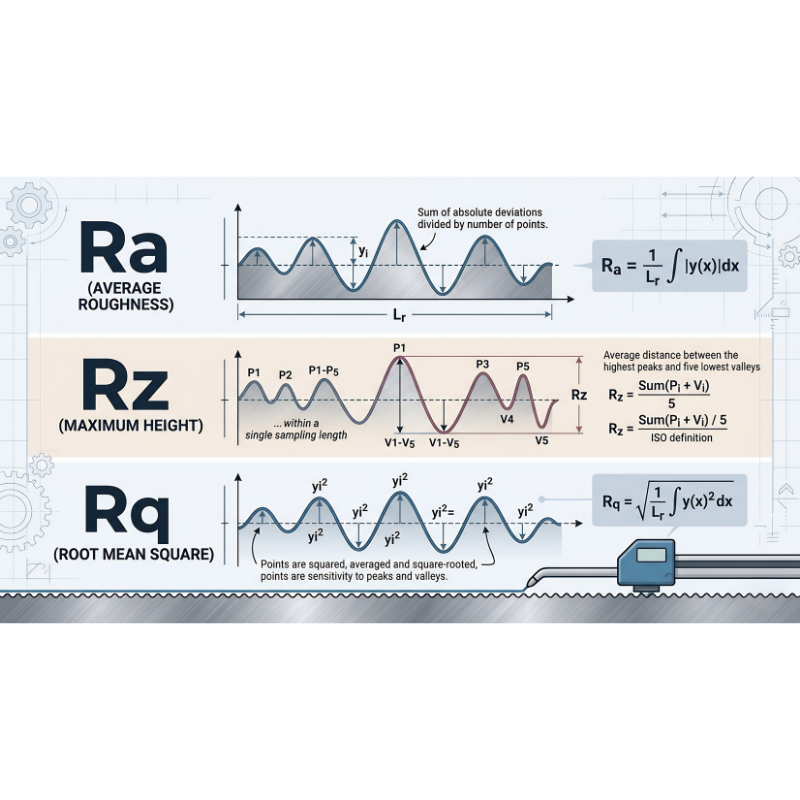
Surface roughness parameters are one of those things that look more complicated on paper than they are in practice. Ra, Rz, Rq, if you've seen these on a drawing and weren't entirely sure which one to pay attention to, or why there are three of them, you're in good company. Most people learn one and quietly wonder about the others for years.
This guide clears that up. What each parameter actually measures, why the differences matter, and how to choose the right one for what you're making.
Every machined, ground, or finished surface has texture at the microscopic level. Run your fingernail across a freshly turned shaft and you can feel it. A faint ridge pattern left by the cutting tool. Surface roughness is the measurement of that texture: the peaks and valleys across the surface at a scale too small to see clearly but large enough to affect how a part performs.
This matters more than people sometimes expect. Surface texture affects:
The tool that measures this texture is called a contact profilometer. Its a device with a fine diamond-tipped stylus that drags across the surface and records every small rise and fall. The resulting profile is then processed into numbers. Ra, Rz, and Rq are three different ways of summarizing that same profile into a single value.
| Parameter | What It Calculates | Most Common Use |
|---|---|---|
| Ra | Average of all deviations from the center line | General machined surfaces, most drawings |
| Rz | Average of the five deepest peak-to-valley heights | Sealing surfaces, fatigue-critical parts |
| Rq | Root mean square of all deviations | Optical surfaces, research applications |
All three come from the same profilometer trace. They're just different math applied to the same raw data.
Ra is the arithmetic mean roughness. In plain language: the profilometer measures how far each point on the surface deviates from the center line, takes all those deviations as positive numbers, and averages them together. One representative number for the whole surface.
It's the most widely used surface roughness parameter in manufacturing, and it shows up on the vast majority of engineering drawings. If a drawing says "125 µin" or "3.2 µm" next to a surface finish symbol, it's almost certainly specifying Ra.
Ra is useful because it's stable and easy to communicate. It doesn't react dramatically to a single scratch or a single high spot, it averages them in. That consistency makes it a reliable indicator of overall surface quality across a production run.
Typical Ra values by process:
Where Ra works well: general-purpose surface finish callouts, supplier specifications, and in-process monitoring on machined surfaces where the function doesn't require something more targeted.
Where Ra falls short: its stability is also its limitation. A surface with one deep scratch and an otherwise smooth texture can produce the same Ra number as a uniformly rough surface. The scratch gets averaged in and mostly disappears. If that scratch is sitting in a sealing groove or on a fatigue-critical part, that's a problem Ra won't flag.
Rz measures something more specific. It divides the evaluation length into five equal sections, finds the tallest peak-to-deepest valley distance in each section, and averages those five values together.
Because it's looking at the worst event in each section rather than averaging everything, Rz is much more sensitive to isolated defects. A single deep valley that barely moves Ra will push Rz noticeably higher. That distinction turns out to be important in several real applications.
Where Rz belongs:
As a rough reference point: for typical machined surfaces, Rz runs about four to seven times Ra. A surface with Ra of 0.8 µm might show Rz around 4–5 µm. That ratio varies by process, but it gives you a sense of the relationship.
Where Rz is less useful: general surface finish communication where Ra is already well understood and the function doesn't call for defect sensitivity. Rz is also slightly more sensitive to measurement noise, so good technique and equipment matter a bit more.
Rq is the root mean square roughness. The calculation is similar to Ra, but instead of averaging the absolute deviations, it squares each deviation before averaging and then takes the square root at the end. Squaring the values means larger deviations get weighted more heavily.
In practice, for most machined surfaces, Rq runs about 1.1 times Ra. That's a small difference, close enough that the two feel nearly interchangeable in typical shop work. Which is largely why Rq doesn't appear often on general engineering drawings.
Where Rq is actually specified:
If you're working in general manufacturing and your drawing doesn't specify Rq, you almost certainly don't need it. Ra and Rz cover the functional ground for the large majority of machined parts.
These don't come up on every drawing, but you'll encounter them eventually.
Rmax (also called Rt) is the single largest peak-to-valley height in the entire measurement. It's the absolute worst-case number, used when even one defect of a certain size is unacceptable.
Rsk (Skewness) describes the shape of the surface profile's distribution whether it's peaks-dominant or valleys-dominant. A negative Rsk means the surface has more valley volume than peak volume, which is what you want for surfaces that need to hold lubrication. Plateau-honed engine cylinder bores target negative skewness deliberately. If you've ever seen a cylinder bore specification that includes both Ra and Rsk, that's why.
Rku (Kurtosis) describes how sharp or blunt the surface peaks are. Sharp peaks wear faster. Broad, rounded peaks carry load better and last longer. Not commonly specified on drawings but useful for understanding surface behavior under contact.
| Application | Parameter to Use | Why |
|---|---|---|
| General machined surface | Ra | Universal, sufficient for most work |
| O-ring or gasket sealing surface | Rz | Catches isolated valleys Ra averages away |
| Fatigue-critical component | Rz | Defect sensitivity matches failure mechanism |
| Engine cylinder bore | Ra + Rsk | Overall texture plus lubrication retention |
| Optical lens or mirror | Rq | RMS correlates with light scatter |
| German or automotive drawing | Ra or Rz | Rz increasingly preferred; check the drawing |
| Coating or paint adhesion surface | Ra or Rz | Either works; Rz better for anchor profiles |
| Bearing journal | Ra + Rz | Average texture and worst-case valley check |
Before leaving this subject, there's one technical point worth understanding: the cutoff filter.
When a profilometer drags its stylus across a surface, it picks up everything, not just roughness, but also the longer, gentler waves of the surface (called waviness) and the overall form. The cutoff filter separates roughness from those longer wavelengths.
Standard cutoff lengths are 0.25 mm, 0.8 mm, and 2.5 mm. The right one depends on the roughness level you expect. For most machined surfaces, 0.8 mm is the default. For very smooth surfaces like ground or lapped parts, 0.25 mm is more appropriate.
Why does this matter? Because measuring the same surface with different cutoff settings can give you different numbers. If you're comparing measurements between your lab and a supplier's lab, or between two different instruments, make sure the cutoff lengths match. It's a small thing that occasionally causes real confusion until someone thinks to check it.
Ra handles the majority of everyday surface finish work. Rz is the right choice when isolated defects matter like sealing, fatigue, German supply chain requirements. Rq belongs in optics and research. Everything else builds from those three positions.
Surface roughness specifications exist to make sure the part performs its function. Once you understand what each parameter is sensitive to, the specification choices become logical rather than arbitrary. That's true for a drawing you're reading, a spec you're writing, or a measurement you're trying to interpret.
Start with what the surface needs to do. The right parameter usually follows from there.