
Call/Text For Fast and Free Shipping! - 617-398-7852
Skip to content

Filters

Microscopes

Explore the Details - Microscopes Collection

Unlock a world of precision and clarity with our Microscopes Collection. Designed for professionals in laboratories, manufacturing, electronics, education, and research, our microscopes offer high-resolution imaging for inspection, analysis, and discovery.

Choose from a wide range of stereo, digital, metallurgical, and biological microscopes—each engineered for accurate magnification, ease of use, and long-lasting performance. Whether you're examining fine components, analyzing biological samples, or conducting quality control, these instruments provide the detail and reliability you need.

Experience exceptional optics and performance with industry-trusted microscopes built to meet the highest standards of precision.

Frequently Asked Questions

If you don't find the answer you're looking for, reach out to use at 617-398-7852

The collection carries 44 Insize microscopes spanning eight distinct instrument types: zoom stereo microscopes (ISM-ZS30, ISM-ZS50/T, ISM-ZS100/T, ISM-ZS200, 5106-M50/T), digital measuring microscopes (ISM-DL300/301/302, ISM-DL400, ISM-DL500, ISM-DL520, 5307-ID100A, 5310-DL401-U, 5318-MD60), digital auto-focus microscopes (5302-AF105, 5303-AF103, 5317-AF109/AF110), metallurgical microscopes (5101-M500-U, 5102-M600-U/BD-U, 5103-M1000-U, 5104-M700, 5108-M3000/M3000H, ISM-M2000), toolmaker microscopes (ISD-VMM205/215/225/235 in binocular and monocular configurations), 3D rotation microscopes (5313-S407, 5301-D400), a polarizing microscope (ISM-POL1000), a horizontal microscope (5316-HM810), and a digital microscope camera accessory (ISM-CM20). The lineup covers everything from entry-level stereo inspection to high-end precision dimensional metrology and advanced materials analysis.

A stereo microscope also called a dissecting or inspection microscope uses two separate optical paths angled slightly apart to deliver a three-dimensional view of the specimen at relatively low magnification, typically 6X to 50X. Unlike compound microscopes that create flat 2D images of thin-sectioned slides, a stereo microscope preserves the depth and surface texture of solid, opaque objects making it the standard tool for PCB assembly inspection and rework, electronic component inspection, gemology, watch and jewelry repair, biological specimen dissection, small part assembly, and incoming quality inspection. Insize zoom stereo microscopes in this collection are the ISM-ZS30, ISM-ZS50/T, ISM-ZS100/T, ISM-ZS200, and 5106-M50/T and cover magnification ranges from 7X up to 50X with zoom ratios up to 8.3:1, binocular and trinocular configurations, and wide-field 10X eyepieces.

A metallurgical microscope is a compound microscope configured for reflected light (epi-illumination) rather than transmitted light, allowing examination of opaque specimens like polished metal surfaces, semiconductor wafers, ceramics, and coatings that cannot be backlit through a slide. The objective focuses light onto the sample surface from above, and the reflected light forms the image. This makes metallurgical microscopes indispensable for microstructure analysis of metals (grain size, phase distribution, inclusion content, heat treatment verification), weld quality assessment, coating thickness and adhesion evaluation, fracture surface analysis, and hardness indent measurement after Vickers or Brinell testing. Insize metallurgical microscopes in this collection range from the 5101-M500-U (50X–500X, bright field) and 5102-M600-U (50X–600X) up to the professional-grade 5108-M3000/M3000H (50X–500X optical, up to 1000X with optional 100X objective) and ISM-M2000, with the 5102-M600BD-U adding dark field objectives for surface defect detection that bright field alone cannot reveal.

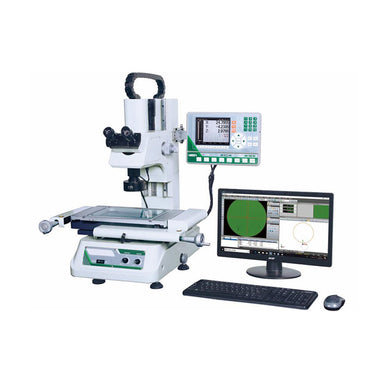
A toolmaker microscope is a precision coordinate-measuring optical instrument is fundamentally different from inspection or analysis microscopes in that its primary purpose is dimensional measurement rather than visual examination. It combines a precision X/Y (and sometimes Z) stage with micrometric or encoder-based position readout, an optical eyepiece or digital imaging system, and reticle-based or digital angular measurement capability, all mounted on a rigid stand designed for metrology-grade vibration resistance. The Insize ISD-VMM Series offers five models spanning stage travel from 5.91×3.94" (ISD-VMM205D/205) up to 11.81×7.87" (ISD-VMM235), Z-axis travel up to 7.87", metal stages up to 19.69×12.99", glass stages up to 13.78×9.84", in both binocular and monocular head configurations. These instruments measure thread profiles, tool geometry, gear tooth form, hole locations, and complex 2D part geometries with the resolution and repeatability that quality labs and toolrooms require for inspection documentation.

A digital measuring microscope replaces or supplements optical eyepieces with a CMOS camera sensor that captures the magnified image on a built-in display or computer screen, enabling real-time image capture, measurement, annotation, and reporting that purely optical instruments cannot support. Key advantages include the ability to share live images with multiple viewers simultaneously, measure features directly on the displayed image using software calipers and geometric tools, capture still images and video for documentation and traceability, and use the screen rather than strained eyepieces for extended inspection sessions thus reducing operator fatigue. The Insize digital measuring microscope range in this collection spans from the 5318-MD60 (12.5X–80X, 1080P, 2MP) through the ISM-DL500 (30X–200X, 5MP, 3072×1728 resolution) up to the 5310-DL401-U with a 4K sensor (8MP, 2840×2160, 17.6X–120X) offering progressively higher image resolution for increasingly demanding inspection and documentation applications.

Focus stacking is a computational imaging technique that captures a series of images at different focal depths and algorithmically combines the in-focus regions from each frame into a single composite image that is entirely sharp from front to back. A standard microscope at high magnification has an extremely shallow depth of field even a surface with even modest topographic variation will have some regions sharp and others blurred in any single frame. Focus stacking solves this by motorizing the Z-axis to sweep through focus positions and fusing the results, producing a fully sharp image of a rough, textured, or three-dimensional surface at magnifications where it would otherwise be impossible to see the entire feature in focus simultaneously. The Insize ISM-DL520 automates this process with motorized focus stacking (24.5X–204.5X, 1080P, 1/2" CMOS), making it well-suited for circuit board solder joint inspection, additive manufacturing surface analysis, and tool wear characterization.

3D rotation microscopes are industrial inspection systems that combine a camera-based digital microscope with a motorized or manual rotation stage, allowing the specimen to be tilted, rotated, and viewed from any angle without repositioning by hand and providing a comprehensive three-dimensional view of complex geometries, connector pins, solder joints, or surface features that would be hidden or foreshortened in a top-down view. The Insize 5313-S407 is the manual rotation variant (18X–120X, 0.09×0.06" to 0.63×0.35" view field, 45° rotation, 1080P display), while the 5301-D400 motorizes the rotation stage for more precise, repeatable angular positioning. Both are specifically suited to electronics inspection, connector and pin array examination, and any application where the feature of interest wraps around a curved or complex surface.

A polarizing microscope inserts polarizing filters (a polarizer below the specimen and an analyzer above it) into the optical path. When the two filters are crossed at 90°, only light that has been rotated in polarization by the specimen passes through, revealing birefringent materials that are otherwise transparent or featureless under normal illumination. This makes polarizing microscopy the standard technique for identifying and characterizing crystalline minerals and geological thin sections, polymer film birefringence and stress, fiber orientation in composite materials, pharmaceutical crystalline forms, and residual stress in glass or ceramic components. The Insize ISM-POL1000 covers 40X–600X magnification with a 10X wide-field eyepiece, working distances from 0.01" to 0.87", a rotating stage, and a numerical aperture specification suited to geological, materials science, and quality lab applications.

The Insize 5316-HM810 is a horizontal-configuration optical microscope (the optical axis is horizontal rather than vertical) meaning the specimen is presented to the microscope from the side rather than lying flat on a stage. This configuration is specifically designed for measuring features on the vertical surfaces of parts that cannot be laid flat, such as the form and thread profile of screws and threaded rods, the tip radius and edge geometry of cutting tools, the profile of gear teeth viewed end-on, and the cross-sectional geometry of wire, tubing, or extruded profiles. At 10.5X–62.5X magnification with a 1/2.8" CMOS sensor, 1920×1080 resolution, and a 4.53" working distance, the HM810 is a production floor and toolroom instrument for tool geometry inspection and turned-part profile verification tasks where standard vertical microscopes are simply the wrong configuration.

All microscope orders ship free to the continental USA, backed by a best-price guarantee. A 30-day return policy and Affirm financing at checkout are available across the full lineup. Government agencies, research institutions, universities, and defense contractors can submit an RFQ through the dedicated Government RFQ page (DUNS: 13-715-2209, CAGE: 15F67). Microscope selection involves several interacting decisions such as instrument type, magnification range, sensor resolution, stage size and travel, binocular vs. monocular vs. trinocular configuration, display vs. no display, and whether dimensional measurement software is required. Gustavo personally reviews every order and is available to help buyers identify the right instrument for the application simply call or text 617-398-7852, Monday through Friday, 8am–5pm EST.