
Call/Text For Fast and Free Shipping! - 617-398-7852
Skip to content

Filters

Hardness Testers

Accurate Material Testing - Hardness Testers Collection

Ensure material strength, durability, and quality with our comprehensive collection of Hardness Testers. Designed for precision and reliability, these hardness testers are essential tools in manufacturing, metalworking, research, and quality control environments.

Our selection includes Rockwell, Brinell, Vickers, and portable hardness testers to suit a wide range of materials and applications. Whether you're testing metals, plastics, or composites, these instruments deliver consistent and accurate results that meet global testing standards.

Built for ease of use and long-term performance, our hardness testers help you maintain high production standards and ensure compliance with critical specifications.

Frequently Asked Questions

If you don't find the answer you're looking for, reach out to use at 617-398-7852

The collection carries hardness testers across three brands, Phase2+, Insize, and Starrett and five distinct testing technologies: Rockwell (including Superficial Rockwell), Brinell, Vickers (Micro and Macro), Leeb (portable dynamic), and Ultrasonic Contact Impedance (UCI). Instruments span from compact portable Leeb testers designed for fieldwork to fully automated benchtop systems for high-throughput QC labs, covering an exceptionally wide range of materials, part sizes, and testing environments.

Each method uses a different indenter geometry, load, and measurement approach suited to different materials and applications. Rockwell testing applies a diamond or ball indenter under a defined load and measures indentation depth which is fast, direct-reading, and widely used for metals in manufacturing and heat treat QC. Brinell testing uses a large carbide ball under high force and measures the diameter of the resulting impression using a microscope which is best for coarse-grained materials like castings, forgings, and raw stock where the large impression averages out microstructural variation. Vickers testing uses a diamond pyramid indenter under a very small, precisely controlled load and measures the diagonal of the impression optically which is the most versatile method, applicable to thin sections, coatings, case depths, and micro-hardness mapping where Rockwell and Brinell indentations would be too large or destructive.

A Twin Rockwell tester performs both standard Rockwell testing (10 kgf minor load, 60/100/150 kgf major loads using scales HRA through HRV) and Superficial Rockwell testing (3 kgf minor load, 15/30/45 kgf major loads using scales 15N through 45Y) in a single instrument. The need for both arises when your work spans multiple material types for example, a lab that tests both through-hardened tool steel (HRC scale) and thin case-hardened or nitrided surfaces (superficial scales) would otherwise require two separate benchtop instruments. Phase2+ Twin Rockwell testers like the 900-387 and 900-475 consolidate all 30 Rockwell and Superficial Rockwell scales into one platform, with automatic conversion to HB and HV, eliminating instrument changeover and reducing capital expenditure.

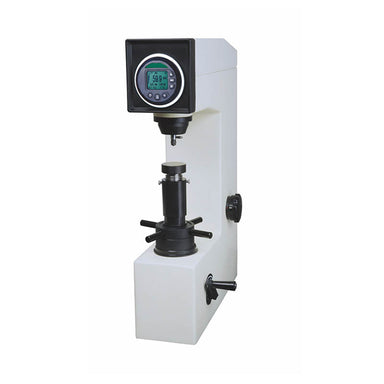
Traditional Rockwell testers apply test force using dead weights and lever mechanisms which is a design that is susceptible to mechanical wear, friction variability, and vibration over time. Load cell technology replaces that dead-weight system with a precision electronic force sensor in a closed-loop control circuit that actively measures and corrects the applied force throughout the test cycle. Phase2+ load cell Rockwell testers like the 900-367 and 900-387 achieve 0.01 HR resolution which is ten times finer than comparable motorized instruments by eliminating the mechanical force variability inherent to conventional designs. For regulated industries like aerospace (NADCAP), automotive (IATF 16949), and medical devices (ISO 13485), load cell instruments provide the force accuracy and traceability documentation that quality system audits require.

Leeb (or dynamic) hardness testing measures the ratio of the rebound velocity to the impact velocity of a spring-driven impact body against the material surface. The result is expressed as an HL (Hardness Leeb) value and can be automatically converted to HRC, HRB, HB, HV, and other scales. Portable Leeb testers like the Phase2+ PHT-1700/1750/1900 series, the Phase2+ PHT-2100, and the Insize ISH-PHB are the right choice when the part cannot come to the instrument, test pieces like large fabrications, installed machinery, structural components, pressure vessels, and heavy forgings that are impractical to move to a benchtop tester. They are compact, battery-powered, and deliver results in seconds, making them standard tools for incoming material inspection, on-site quality audits, and maintenance programs.

Ultrasonic Contact Impedance (UCI) hardness testing works by pressing a Vickers diamond indenter vibrating at ultrasonic frequency into the material surface. The change in resonant frequency is proportional to the size of the indentation and therefore the hardness. Phase2+ UCI testers like the PHT-6000 Series, PHT-6011, PHT-6030/6080, and PHT-6100 are particularly well-suited for testing small, thin, or lightweight parts where the impact of a Leeb device would cause the part to move or ring, compromising the measurement. UCI testing also works well for case depth verification, coatings, weld inspections, and parts with curved or irregular surfaces. The PHT-6100 adds a motorized probe drive for consistent, operator-independent force application, eliminating the manual load variation that can affect UCI accuracy.

Micro Vickers testing uses very small loads, typically from 10 gf up to 1 kgf to produce indentations small enough to measure individual microstructural features, thin coatings, case depths, heat-affected zones, individual weld beads, and small electronic or medical components. The Phase2+ 900-390 and 900-391 Micro Vickers testers and the fully automated Phase2+ 900-505 are designed for these precision applications. The 900-505 which is the most advanced in the collection is fully automated with motorized X/Y stage traversal, auto-focus, and automatic indentation measurement software, making it suited for high-throughput case depth profiling and microhardness mapping without manual microscope reading between tests. The Insize 9631-130 Vickers Hardness Measuring System adds USB connectivity and automatic indentation measurement via CMOS camera for labs that want to upgrade an existing Vickers tester with digital measurement capability.

Magnetic Rockwell testers like the Insize ISHR-M111, ISHR-B141, and ISHR-D121 are designed to attach directly to large, heavy ferrous parts such as structural beams, large castings, pipes, pressure vessels, and heavy machinery frames that cannot be placed on the anvil of a standard benchtop tester. A powerful magnet in the base clamps the instrument securely to the part surface, and the hardness test is performed in situ at any orientation, including vertical or upside-down. The ISHR-D121 adds a digital display and extended measurement range, while the ISHR-B141 covers both Brinell and Rockwell scales for versatility on large components. These instruments bridge the gap between benchtop accuracy and the field portability of a Leeb tester, retaining true Rockwell methodology on parts that simply won't fit in a standard frame.

Standards compliance varies by method and instrument. Phase2+ Rockwell testers comply with ASTM E18, with ASTM E18-20 certification available for regulated customers in aerospace, automotive, and defense. Brinell testers comply with ASTM E10 and ISO 6506. Vickers and Micro Vickers testers comply with ASTM E384 and ISO 6507. Leeb portable testers comply with ASTM A956 and ISO 16859. Insize instruments reference relevant ISO and ASTM standards specific to each test method. For industries operating under NADCAP, AS9100, IATF 16949, or ISO 13485 quality management systems, many models in this collection are available with calibration certificates and formal instrument certification documentation, confirm requirements with Gustavo before ordering.

All hardness tester orders ship free to the continental USA, backed by a best-price guarantee. A 30-day return policy and Affirm financing at checkout are available for all instruments. Government and institutional buyers can submit an RFQ through the dedicated Government RFQ page. Hardness testers are among the most application-specific instruments in metrology and the right choice depends on your material type, part geometry, required scale, production volume, and quality system documentation requirements. Gustavo personally reviews every order and encourages buyers to call or text 617-398-7852 before purchasing, Monday through Friday, 8am–5pm EST, to ensure the right instrument for the application.